
The universe has a way of reminding us how small and how interconnected we really are. For decades, astronomers viewed our solar system as a self-contained bubble, a celestial neighborhood where neighbors rarely changed. This perspective changed forever with the discovery of ‘Oumuamua (1I) in 2017, the first confirmed visitor to another star system. This was followed in 2019 by the comet-like 2I/Borisov.
Now both the scientific community and space enthusiasts are setting their sights on the next great mystery: 3i atlas. As the third designated interstellar object (3I), this visitor represents more than just a passing rock; It is a physical messenger from the Sun, which we will probably never visit, bringing chemical secrets from a corner of the galaxy millions of light years away.
3i atlas findings
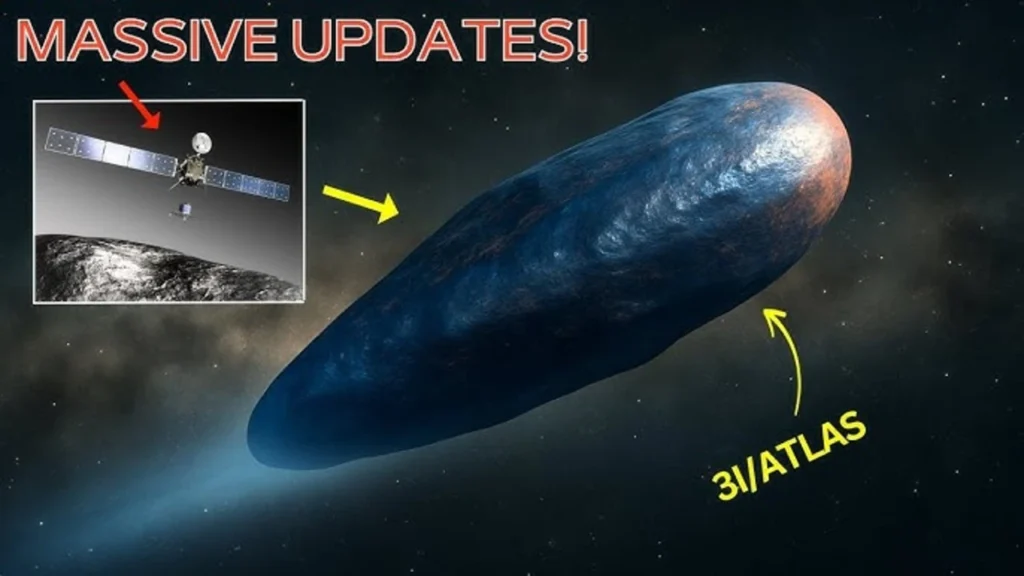
The name of this object is no coincidence. The “3i” designation marks it as the third confirmed interstellar interstellar, while “ATLAS” refers to the system that first noted its unusual behavior. The Asteroid Terrestrial-Impact Late Warning System (ATLAS) is a robotic astronomical survey and early warning system designed to detect small near-Earth objects. When it turned its attention to this specific anomaly, scientists realized they weren’t looking at a standard local asteroid.
To understand what is 3i atlas is, we first need to look at its speed. Unlike objects born in our solar system, which follow predictable elliptical orbits around our sun, this object arrived at “excessive hyperbolic velocity.” Simply put, it was traveling too fast to be bound by the Sun’s gravity. It wasn’t from here; It was just to pass by.
This 3i/atlas interstellar object immediately stood out due to its unique light curve. As it fell into space, the way it reflected sunlight revealed a shape that was far from spherical. Like its predecessors, it sparked a wave of curiosity: Was it a piece of a destroyed planet? A frozen nitrogen iceberg? Or something even more exotic?
Decoding the 3i/atlas Interstellar Object
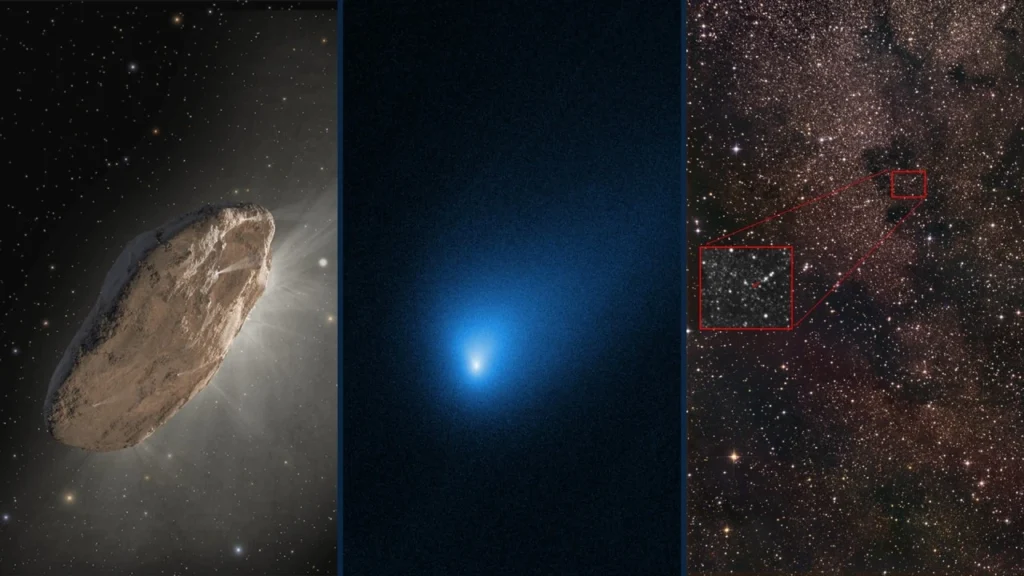
When we analyze a 3i/atlas interstellar object, we are essentially performing a cosmic autopsy from a distance. Because we cannot (yet) observe these fast-moving targets, we rely on spectroscopy the study of light. By looking at the colors of light absorbed and reflected by an object, scientists can determine what it is made of.
Preliminary data suggest that 3i atlas shares some similarities with 2I/Borisov, in that it exhibits a faint “coma” or gas tail. This suggests the presence of volatiles ice that turns to gas as the object gets closer to the sun’s heat. However, unlike a standard comet, its chemical signature shows high concentrations of heavy metals, leading some to believe it originated in a system with a very metal-rich star, perhaps in the galactic center.
The sheer speed of the 3i atlas truly boggles the mind. It rotates relative to the Sun at a speed of tens of kilometers per second. This movement confirms its status as an interstellar traveler. If it were a local object, the Sun’s gravity would slow it down or keep it in a closed loop. Instead, 3i atlas is on a one-way path, a cosmic “drive-by” that gives us only a few months of prime time before it disappears back into the void.
Should we be worried? Did 3i/Atlas hit the ground?
When a new object is detected by an “impact alert system”, the public’s first question is naturally about security. Social media is often full of rumors and sensational headlines. You may have seen searches asking if 3i/atlas hit earth.
The short answer is definitely not.
3i atlas passed at a distance from our inner solar system that, despite being “close” in astronomical terms, is still millions of miles from our atmosphere. NASA and other international space agencies track these objects with extreme precision. The orbital mechanics of the 3i/atlas interstellar object were calculated several weeks ago, leading to an orbit that safely cleared the Earth-Moon system.
While the idea of an interstellar object hitting Earth is a popular theme for science fiction movies, the reality is that space is incredibly empty. The probability of a rogue object from another star system hitting a particular planet is very low. Rather than a threat, the 3i atlas provided a unique opportunity for planetary defense systems to practice tracking high-velocity targets, ensuring that if a real threat ever arose, we would be ready.
Why the 3I Atlas is important to science
You may wonder why we spend millions of dollars and thousands of man hours tracking a rock like the 3i atlas. The reason for this lies in the origin of life and the formation of planets.
Each solar system is a time capsule. Our own Earth, Mars and Jupiter were formed from a peculiar mixture of gas and dust that surrounded the Sun 4.5 billion years ago. Studying the 3i atlas gives us an example of another recipe. It’s like a chef who has only ever cooked with local ingredients suddenly being handed spices from a continent he’s never heard of.
By understanding what 3i Atlas is made of, we can answer basic questions:
- Is our solar system normal? Do 3i/atlas interstellar object have the same ratio of carbon to oxygen as our comet?
- Can life travel between the stars? The theory of panspermia suggests that the building blocks of life (amino acids or even hardy microorganisms) can travel on interstellar rocks.
- How do planetary systems die? Many of these objects are ejected when a star dies or when the gravity of a giant planet ejects them. 3i Atlas may be a remnant of a solar system that no longer exists.
Challenges of observing the 3I Atlas
Capturing clear data on the 3i Atlas is no mean feat. Because it rotates so fast, telescopes have a narrow window to lock onto it. Ground-based telescopes must contend with Earth’s atmosphere, which can blur images. To get the best results, we rely on the Hubble Space Telescope and the James Webb Space Telescope (JWST).
3i/atlas interstellar object Using JWST to observe interstellar objects has been a game-changer. JWST’s infrared capabilities allow us to see the object’s heat signature and identify complex organic molecules that would be invisible to other instruments. Every hour of observation is precious, as 3i Atlas is currently retreating from the Sun, cooling and disappearing into the darkness of interstellar space.
Future missions: Can we capture 3i atlas?
The discovery of 3i Atlas has reignited interest in “interstellar interceptor” missions. Currently, our fastest spacecraft (such as Voyagers) are moving much slower than the 3i/atlas interstellar object. To catch one, we would need a spacecraft “parked” in orbit, waiting for the next discovery to be announced.
The European Space Agency (ESA) is actually planning a mission called the Comet Interceptor, which could potentially be redirected if a new 3i Atlas like object is found in time. Imagine the scientific windfall of returning a physical sample from an interstellar visitor. This would be the most important archaeological discovery in human history – the “culture” we are studying is an alien star system.
Frequently Asked Questions (FAQ)
1. What exactly is the 3I ATLAS?
3i Atlas is a premium luxury residential project by 3i Developers. It has exclusive apartments with modern design and facilities. The project is located in Bangalore and targets exclusive urban living.
2. Will we see the 3I ATLAS?
Yes 3i Atlas is a real project that you can visit and see. It is a luxury residential development by 3i Developers in Bangalore. You can view the website, model units and marketing materials in person or online.
3. Can I see the 3I ATLAS from India?
Yes, you can see the interstellar comet 3I/ATLAS from India with the right equipment. It will not be visible to the naked eye, but amateur astronomers across India (including with powerful telescopes) are monitoring and imaging it as it moves across the sky.
4. What does NASA say about the 3I ATLAS?
NASA says 3i Atlas is a natural interstellar comet, not an artificial one. It originated outside our solar system and is just passing through. NASA has confirmed that there is no threat to Earth from this.
5. What asteroid has a 3% chance of hitting Earth?
The asteroid that briefly had about a 3% chance of hitting Earth is 2024 YR4, a near-Earth “city killer” rock that was first observed in late 2024. It was once estimated to have about a 3.1% chance of hitting Earth on December 22, 2032, before further observations significantly reduced the risk.